Teen girls today are growing up in a world that demands a lot from them.
Constant comparisons, pressure to perform, and a never-ending scroll of curated perfection.
Underneath it all, many are left wondering: Am I enough? Where do I fit in? What does strength even look like?
And while some of those questions are a natural part of adolescence, the answers often come from what – and who – they see around them. Positive role models don’t just set an example. They reflect back what’s possible. When a young woman sees someone lead with honesty, bounce back from hardship, or simply show up as themselves with confidence, it gives her permission to do the same. Even one example of real, grounded strength can plant the seed of self-worth.
The Impact of Positive Role Models on Confidence and Self-Worth
Whether it’s a therapist who listens without judgment, a mentor who shares their own recovery journey, or a character in a book who dares to speak the truth – positive role models shape how young girls see the world, and how they see themselves within it.
According to the nonprofit Girlguiding’s Girls’ Attitudes Survey, only 25% of girls feel confident in their lives, and half report feeling anxious about their futures. In this context, mentors who model resilience, honesty, and self-respect become vital beacons of hope. These role models don’t need to be perfect…just real. Their everyday strength reminds girls that overcoming challenges is part of becoming the person they’re meant to be.
The teenage years are filled with uncertainty. Identity shifts, emotional highs and lows, and the pressure to figure everything out at once. But behind the smiles and social media filters, many teens are quietly asking for guidance. They’re looking for someone to show them what it means to be brave, to be soft, to be human.
At Roots Renewal Ranch, we see that spark come alive when our girls connect with someone who truly understands them. Role models don’t pave the path. They light it up. When a girl sees someone who looks like her chase dreams unapologetically, it sends a powerful message: You can, too.
What Makes a Good Role Model? It’s Not About Perfection.
When we talk about role models for teen girls, we’re not talking about perfect people with flawless lives. The best role models are those who show up as they are – honest, brave, and still actively growing. Sometimes, the most powerful inspirations are those who have lived through something hard and come out the other side with purpose. Research shows that adolescents who identify with their role models report higher self-esteem and confidence, especially when they see traits they can relate to.
Below are some of the core traits that make a role model impactful. Not just in words, but in presence.
Authenticity: Being Real, Not Perfect
Authentic role models don’t hide behind a mask. They share their truth – both the strengths and the stumbles. For teen girls who often feel pressure to perform or appear “okay,” seeing someone speak openly about their feelings can be life-changing. Authenticity builds trust and creates space for vulnerability, reminding girls that they don’t have to pretend to be perfect to be worthy of love or support.
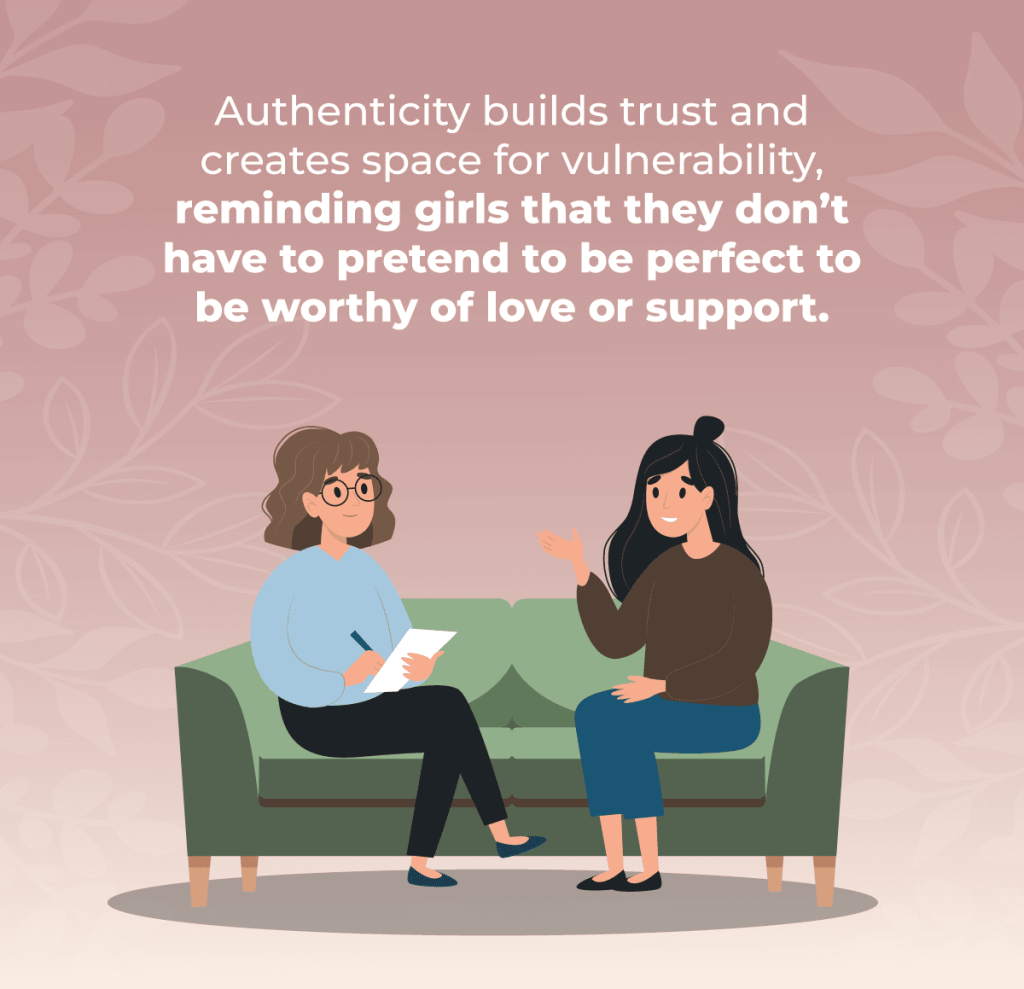
An excellent example of this is a mentor sharing how she overcame her own self-doubt by journaling daily and speaking candidly about the days she missed. This kind of honesty gives girls permission to be real about their own progress.
Emotional Resilience: Feeling It All, and Getting Back Up
True resilience isn’t about staying strong all the time. It’s about navigating hard emotions and learning how to recover from them. According to a 2022 study in Child and Adolescent Psychiatry and Mental Health, teens who learn emotion regulation strategies (especially when modeled by trusted adults or peers) are significantly more likely to bounce back from distress and avoid long-term emotional difficulties.
This kind of emotional resilience is foundational in recovery. When teen girls see someone acknowledge pain without being defined by it, they learn that their hardest days don’t have to shape their future.
Compassion: For Others and Themselves
A role model’s greatest act isn’t teaching. It’s caring. When this role model says, “I once felt the same way,” she builds an empathetic bridge. Compassion doesn’t just come from talking – it’s in how a staff member at Roots paused mid-session to ensure a girl felt heard, or how a peer mentor sat beside her friend after she broke down. Not to fix, but to witness.
Compassionate role models remind girls that they are not broken – they’re human. And that healing isn’t just about recovery, it’s about learning to love yourself through it.
Integrity: Walking the Talk
Teens are great at spotting inconsistencies. A strong role model is someone who doesn’t just say the right things — they live them. They hold boundaries, speak honestly, and make decisions aligned with their values. Even when it’s hard. For instance, a role model apologizing for snapping and then taking restorative action. That consistency builds emotional safety in relationships.
In a recovery setting, integrity is more than a virtue. It’s a stabilizer. Girls at Roots witness firsthand how integrity builds trust, rebuilds self-worth, and lays the groundwork for healthy relationships.
Healthy Boundaries: Teaching What Safe Connection Looks Like
Strong role models don’t just talk about boundaries. They model them with clarity and respect. For teen girls who may have learned to equate people-pleasing with connection, this kind of example can be eye-opening. It might look like a mentor saying, “I care about you, but I also need space to take care of myself.” That simple statement teaches that boundaries aren’t rejection, they’re a form of mutual respect.
Studies show that teens who observe healthy boundary-setting are more likely to develop stronger self-worth and emotional regulation. The key foundations for safe and lasting relationships.
Real Stories with Real Impact – “I’ve Been There Too.”
Some of the most transformative role models aren’t celebrities or public figures at all. They’re women who’ve walked the path themselves. Peer mentors, older alumni, and staff in recovery bring a unique perspective to the healing process: their lived experience. Their presence is a quiet, powerful reminder that healing is possible.
Meeting someone who’s walked a similar path and come out the other side can feel like finding solid ground for the first time. Research shows that same-gender role models with relatability – someone whose mistakes and background echo their own – have a stronger impact on self-esteem. That’s why Roots’ peer mentors, who are often alumni, are not extras in recovery. They’re anchors: “I’ve been there. You’re not alone.”
These role models don’t need to have it all figured out. They embody the truth that recovery isn’t about perfection – it’s about progress, growth, and believing in something better.
What Parents and Caregivers Can Do: Modeling Strength with Vulnerability
As a parent or caregiver, you’re one of the most powerful role models in your teen’s life – even if it doesn’t always feel that way. The way you handle stress, relationships, and self-growth teaches your daughter far more than words alone ever could. By modeling emotional honesty and resilience at home, you give her permission to be human, to grow, and to reach for the kind of life she deserves.
Helping your teen find positive role models outside the home matters, too. Whether it’s through books, social media, or real-life role models, guiding her toward strong, kind, and grounded influences can shape how she sees herself and what she believes is possible.
Here are a few simple but powerful ways to lead by example:
- Be open about your own growth. Talk about times you learned something the hard way or had to course-correct without shame.
- Point out healthy role models in real life. When you see someone navigating conflict, grief, or purpose with courage, name it. Say why it stood out.
- Ask your teen who inspires her, and why. This can spark rich conversations about values, self-image, and ambition.
- Encourage media with meaning. Help her find books, movies, or creators that reflect real strength, not perfection.
- Celebrate small wins. Whether it’s setting a boundary or showing kindness, highlight these moments as evidence of character and growth.
The role models she sees – and the ones you reflect – help her imagine what kind of woman she wants to become.
Every Girl Holds the Power to Inspire at Roots Renewal Ranch in the Dallas, Texas Area
When young women are seen, supported, and surrounded by people who show up for them, they begin to believe in themselves. They realize that resilience doesn’t mean having all the answers. It means continuing to grow and heal.
At Roots Renewal Ranch, every girl has the potential to become a role model herself, not despite her challenges, but because of the insight and strength she gains through the healing process. Here, that journey doesn’t happen alone. Whether it’s a therapist modeling healthy boundaries, an equine staff member practicing patience and empathy, or a peer mentor offering hard-won wisdom, the girls at Roots are surrounded by examples of growth in motion. Even among themselves, healing happens in companionship – as they support, learn from, and reflect one another’s strengths day by day.

Call us today at 888-399-0489 to learn more about our treatment programs for teen girls.
She is strong, she is loved, and she is enough.
