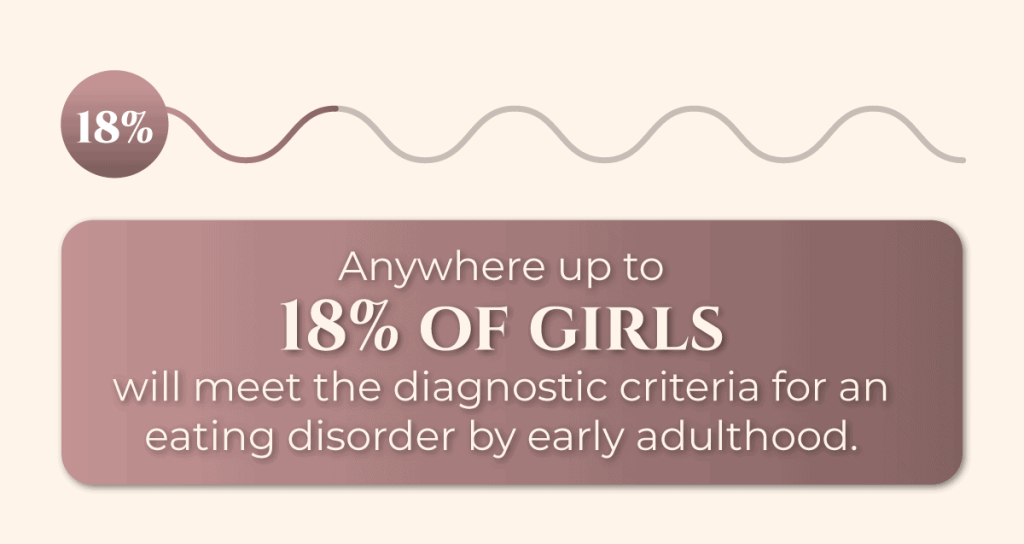
Anywhere up to 18% of girls will meet the diagnostic criteria for an eating disorder by early adulthood. If you need something more concrete to fully grasp that, think of it as at least one girl in every two high school classes with an eating disorder.
These are conditions often lived in secret, entrenched in heavy feelings of shame, guilt, and loneliness. Any mental health condition is difficult to live with, but eating disorders combine the mental and the physical into a unique monster that can feel very scary and overwhelming to fight.
We’ve been working with teen girls for years at Roots Renewal Ranch, and many of them navigate eating disorders and poor body image. These conditions don’t spring up overnight. Eating disorders are active, ongoing conditions that gradually increase in severity when left untreated. The good thing about that is there are ways to intervene before they fully develop and spiral into the dangerous situations we know they can be.
Let’s cover the early signs of eating disorders in teen girls so you can tell if your daughter needs additional support in this area.
How to Recognize Early Signs of Common Eating Disorders in Your Teen Daughter: Defining the Conditions
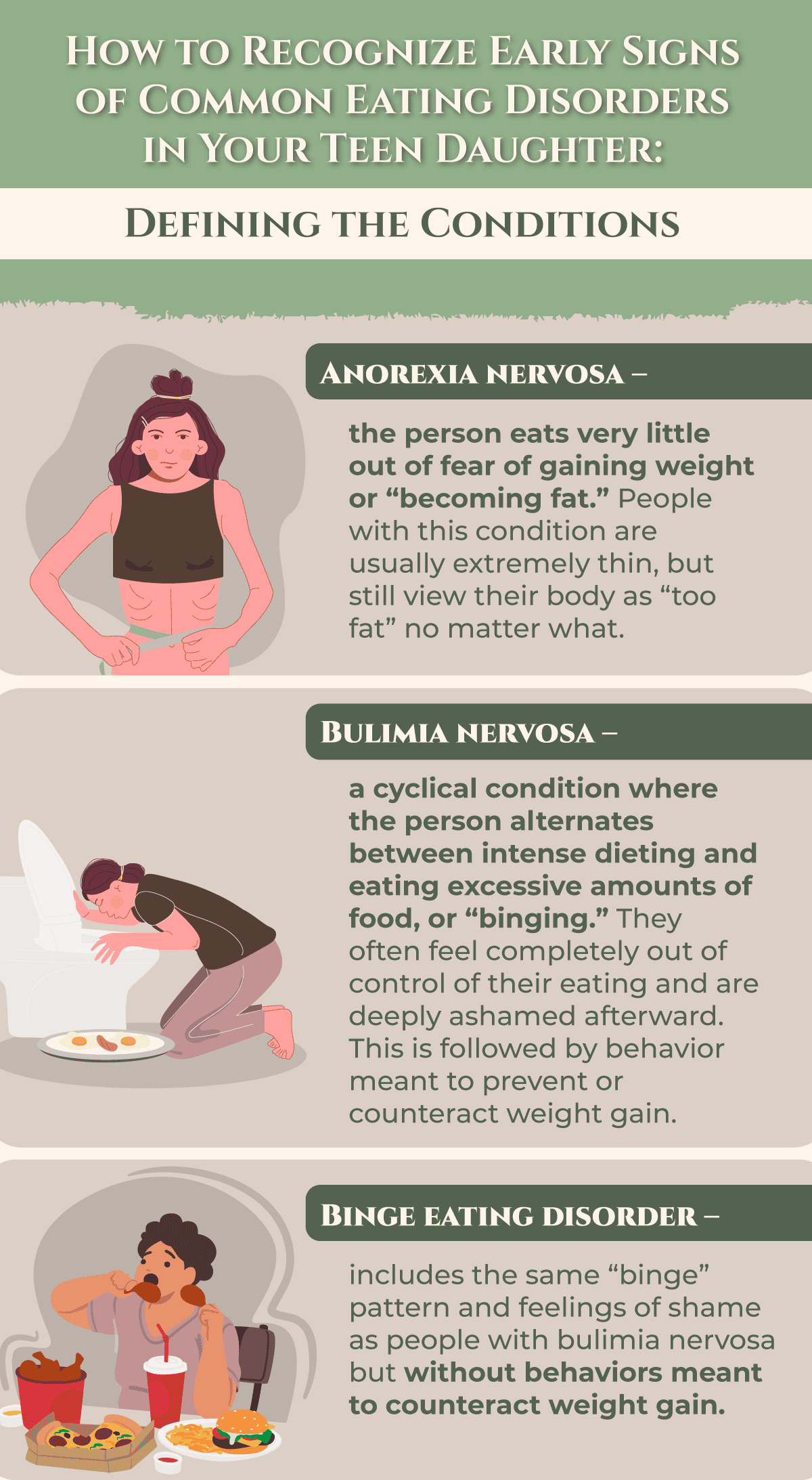
Some signs, such as a preoccupation with their body, are consistent across all eating disorders. Each eating disorder is different, though, and presents differently to some degree. Knowing the three major types of eating disorders will help you better identify what’s going on with your daughter. Let’s go over them.
- Anorexia nervosa – the person eats very little out of fear of gaining weight or “becoming fat.” People with this condition are usually extremely thin, but still view their body as “too fat” no matter what. They also often exercise excessively in hopes of losing more weight.
- Bulimia nervosa – a cyclical condition where the person alternates between intense dieting and eating excessive amounts of food, or “binging.” They often feel completely out of control of their eating and are deeply ashamed afterward. This is followed by behavior meant to prevent or counteract weight gain, such as vomiting, laxative use, or excessive exercise.
- Binge eating disorder – includes the same “binge” pattern and feelings of shame as people with bulimia nervosa but without behaviors meant to counteract weight gain.
All of these conditions can be incredibly dangerous to someone’s health, especially for a teen who is still growing.
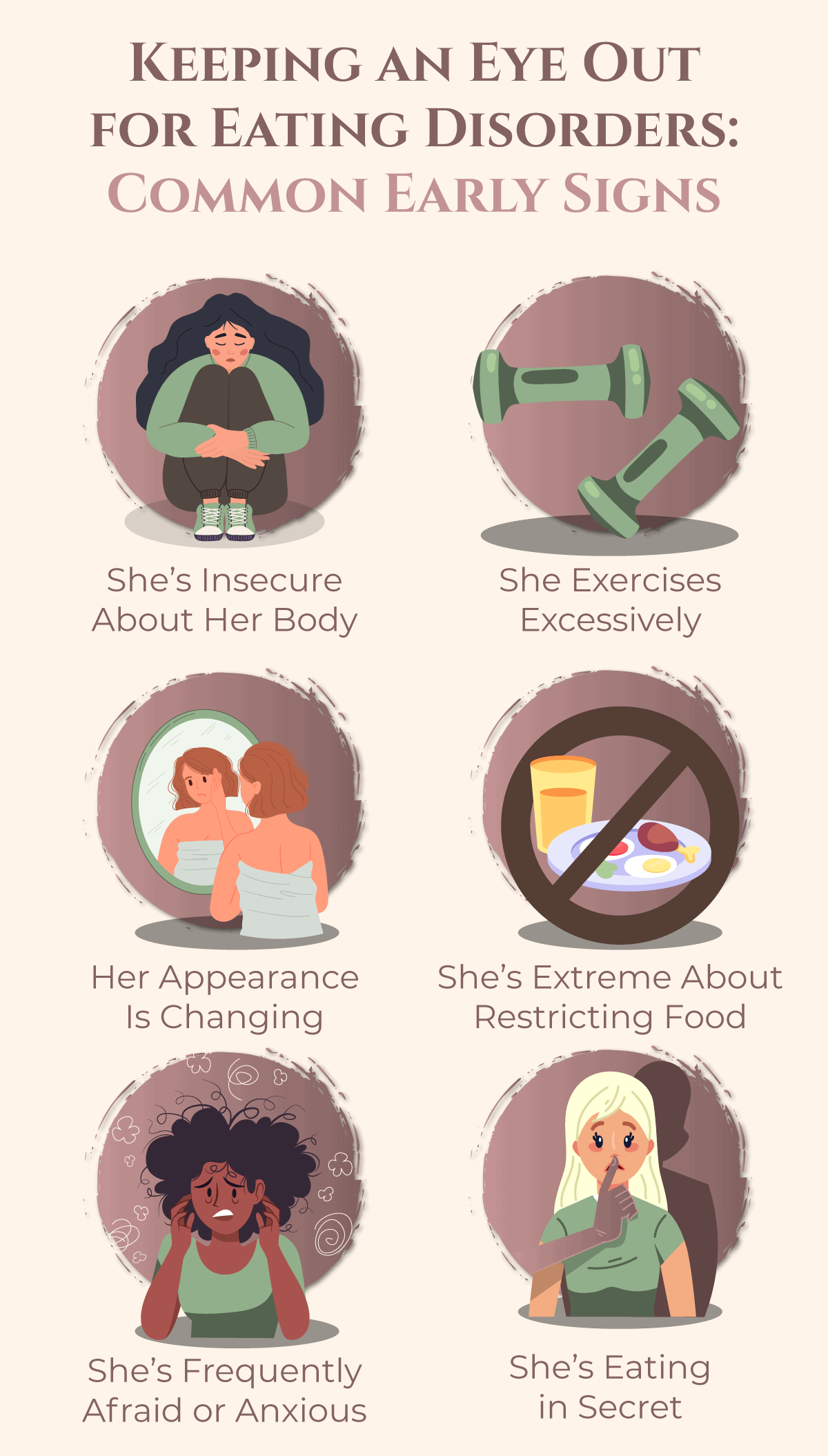
Keeping an Eye Out for Eating Disorders: Common Early Signs
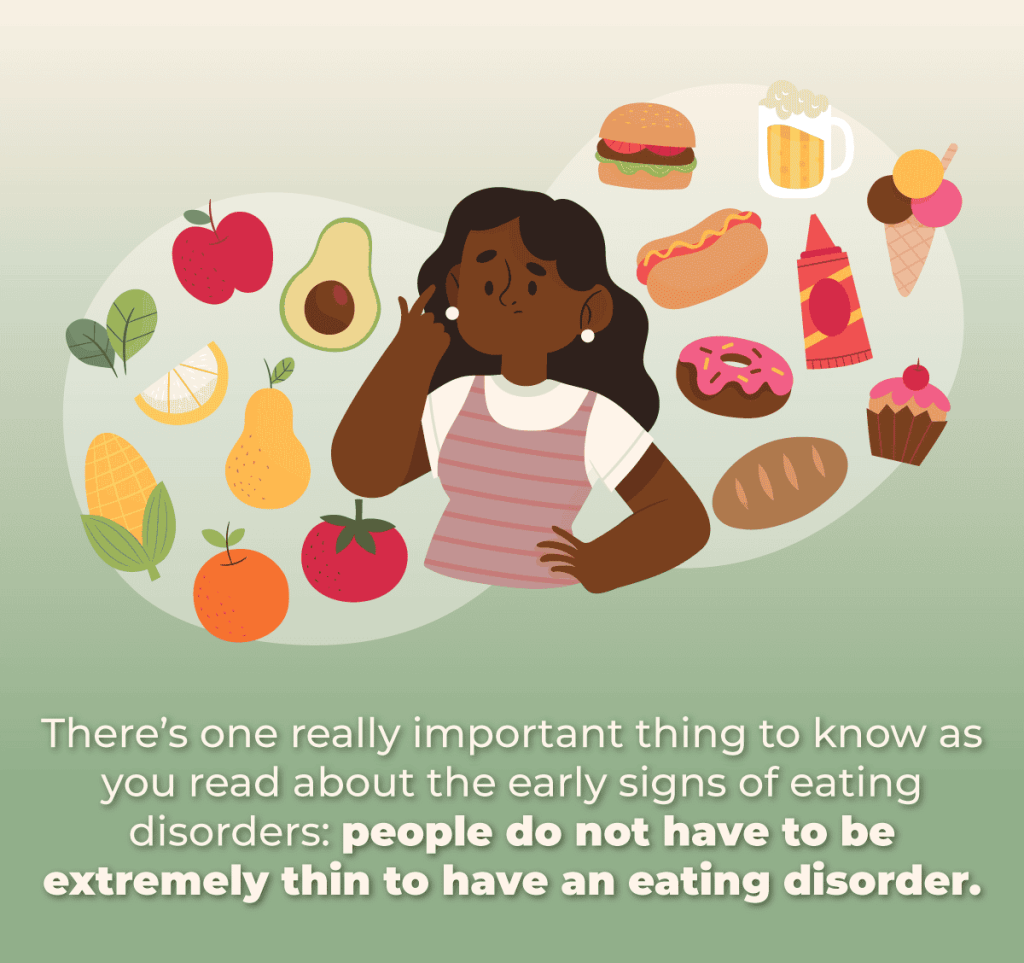
There’s one really important thing to know as you read about the early signs of eating disorders: people do not have to be extremely thin to have an eating disorder. Even if your daughter “looks healthy” on the outside, she could still be managing an eating disorder secretly.
This is especially true for bulimia and binge eating disorders. Not only can your daughter have an eating disorder regardless of her weight, but her condition can take a serious toll on her body internally without anyone knowing.
Eating disorders don’t discriminate, either. They don’t have to make sense – most of the time, they don’t. It can only help to be aware of these signs, so if you notice them in your daughter or someone else in your life, you can provide them with additional support.
She’s Insecure About Her Body
This is a universal concern for all eating disorders. Girls will have a poor body image, and always find something wrong about themselves physically. It’s most frequently weight-related, and girls with anorexia especially will never feel like they’re skinny enough.
If you hear your daughter frequently putting down her own body or talking about how she wants to lose weight, it might be cause for concern. She also might look at her body in the mirror or weigh herself frequently. If she has an eating disorder or is on the path to developing one, she’ll generally fixate on her appearance.
She Exercises Excessively
While exercise is usually healthy, in this case, it’s possible to have too much of a good thing. Some girls with eating disorders become preoccupied with exercising, typically to lose weight. If your daughter sometimes exercises until she collapses, or has injured herself due to over-exercise, it’s a red flag – especially when combined with additional signs.
Her Appearance Is Changing
There are obvious weight-related changes that can happen based on your daughter’s eating habits. She might gain weight because of binge eating patterns and will lose weight if she heavily restricts her diet or stops eating altogether.
Some other things can change too, such as her trying makeup trends to slim her face, or wearing clothing that makes her “look skinnier,” at least in her eyes. She may also hide in baggy clothes more often due to insecurity about her body.
She’s Extreme About Restricting Food
There’s nothing inherently wrong with dieting, especially if it’s for health reasons. Teens dieting for the sake of weight loss unrelated to their health could use a watchful eye from parents.
Dieting of some kind is a key characteristic of anorexia and bulimia nervosa – but girls with these conditions take it to the extreme. Typically, they’ll stick to low-calorie foods and might count their calories and plan meals obsessively. They’ll probably become agitated if other people try to get involved in the process or tell them what to do, and may react extremely emotionally when they feel forced to eat food that falls outside of the rigid rules they’ve set for themselves.
She’s Frequently Afraid or Anxious
Anxiety is like regular fear everyone experiences – except it lasts all the time, even for seemingly no reason, and is usually more intense. Girls with eating disorders often experience anxiety. It can be related to their appearance, or totally unrelated. The key is them constantly being on edge and feeling uneasy, if not terrified.
Girls with eating disorders will often be concerned about others finding out about their eating habits, which can be a source of anxiety for them that shows up in every area of their lives.
She’s Eating in Secret
This is especially common in people who experience binge eating. They’ll often hide food, or eat by themselves, so no one else witnesses how much they eat. They might consume thousands of calories without anyone knowing and typically feel a deep shame or disgust with themselves for it. If you find mysterious empty wrappers and boxes, or significant amounts of food seem to go missing without explanation, your daughter might be binge eating in secret.
Sharing the Burden: How to Talk to Your Teen About Eating Disorders
It’s important to keep in mind that just because your daughter exhibits some of the signs in this blog, it doesn’t necessarily mean she has an eating disorder. It does mean you should talk to her about your concerns no matter what.
You’ll need to go into any conversation you start with your daughter intending to listen and understand her. It might be your instinct to tell her that what she’s doing is wrong or unhealthy, but it’s important to create an environment where your daughter feels safe to open up to you without judgment.
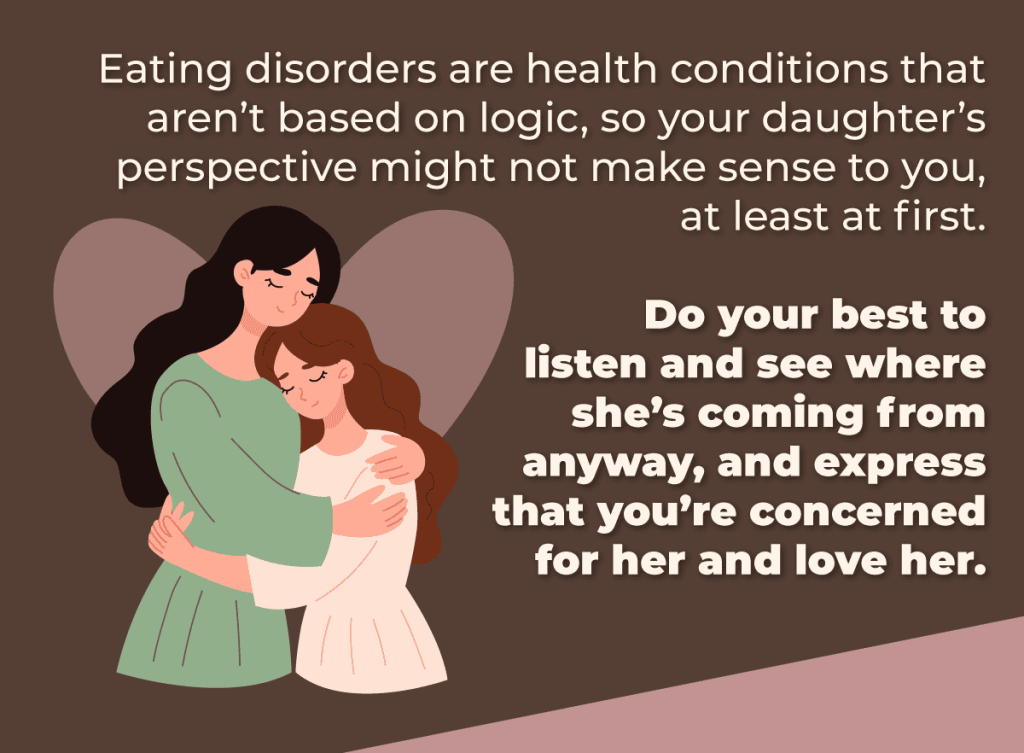
Eating disorders are health conditions that aren’t based on logic, so your daughter’s perspective might not make sense to you, at least at first. Do your best to listen and see where she’s coming from anyway, and express that you’re concerned for her and love her. You can bring up specific things that worry you, too. You might say something like, “I’ve noticed you’re eating less, and always turn people down when they invite you to eat with them. How are you feeling?”
Chances are, your daughter won’t be too keen on opening up to you about her eating disorder if she does have one. Typically, people with eating disorders don’t believe they’re doing anything wrong. Especially in the case of anorexia, they are genuinely convinced their image of their body is accurate, and that they’re doing what’s best. That means they won’t be eager to change their ways, and you’ll need to practice patience.
Even when your daughter pushes you away, keep an eye on her, and regularly ask her how she’s feeling and how you can help. It might be helpful to ask her questions about her eating habits, her body image, and her relationship with food. Always do your best to be a good listener and stay calm. The top priority should always be learning more so you can better understand and help your daughter.
What to Do if You Suspect Your Teen Girl Has an Eating Disorder
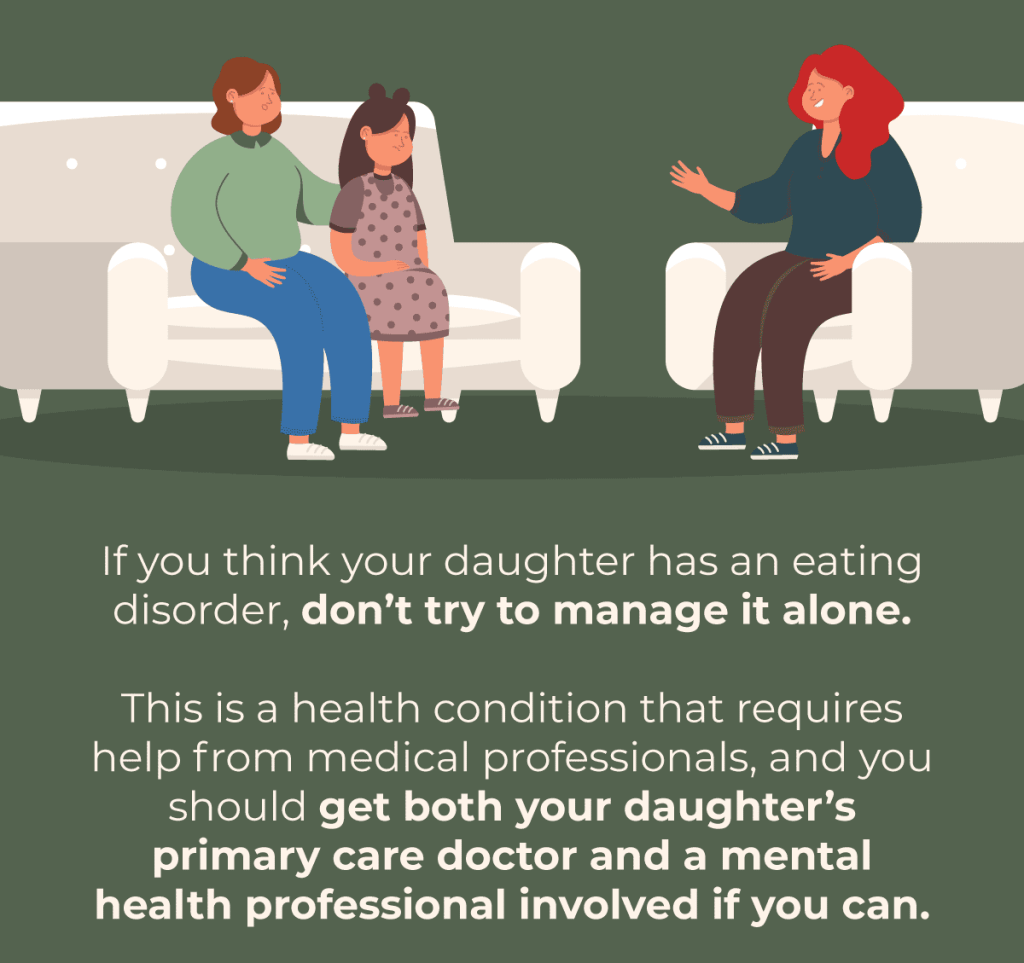
If you think your daughter has an eating disorder, don’t try to manage it alone. This is a health condition that requires help from medical professionals, and you should get both your daughter’s primary care doctor and a mental health professional involved if you can. Call her primary care doctor first. They’ll be able to offer additional advice and might be able to refer you to a specialist they trust.
Eating disorders don’t come out of nowhere. They usually stem from other concerns, such as low self-esteem, bullying, perfectionism, or an untreated mental health condition. No matter what is motivating your daughter’s eating disorder, she could benefit from therapy to talk through anything troubling her. Healing from trauma and mental health conditions helps heal eating disorders, too.
Your daughter will probably be very resistant to treatment at first. It’s important to remember that, especially in the case of anorexia, eating disorders can be life-threatening. While it’s always ideal to get any girl to go along with treatment willingly, you are not a bad parent if you seek treatment for her – even if she doesn’t want it.
Treatment for Teen Girls in Dallas-Fort Worth
Eating disorders are both physical and mental health conditions. They require a whole team to overcome, and mental health treatment will be a huge asset to your daughter as she works to recover.
It will take work, too – from the entire family, not just your daughter. Healing won’t be an easy process, but it will be a worthwhile process. Even if you’re just at the beginning of the journey now, you and your daughter will eventually be able to look back on these difficult early moments and be thankful you took the steps to get help.

Roots Renewal Ranch is a residential facility for girls ages 13-17 in Argyle, TX. Animal therapy is a core part of what we do, and girls who stay with us find comfort in our furry and feathery friends and learn the responsibility it takes to care for them. It’s a process that builds confidence, all while they participate in more traditional talk therapy and focus entirely on their recovery. Your daughter is strong, she is loved, and she is enough. Call us today at 888-399-0489, and let’s work together to help her see it.

