There are mornings when the house is awake.The coffee is brewing …… backpacks are packed… the clock ticking — but your daughter won’t get out of bed.
The covers are pulled tight.The lights off – the door closed.
You call her name once.Then again.
Sometimes she answers.… but not in defiance.She answers with exhaustion. Or overwhelm. Or tears.And sometimes her answer is silence.
For many parents, this moment brings a mix of fear and frustration … and sometimes even helplessness. You may wonder if she’s being resistant or if she is lazy and unmotivated.
But often something deeper is happening that you can’t see.
And you’re not alone in this experience.Neither is she.
Recent research continues to show a significant rise in teen mental health problems. According to the CDC’s 2023 Youth Risk Behavior Survey, rates of persistent feelings of sadness, hopelessness, anxiety, and even depressive symptoms among teen girls continue to remain at historic highs – often presenting more in the morning hours.
For many teens, staying in bed isn’t about avoiding school or responsibility.It’s about trying to avoid the weight of the day ahead.
Why Getting Out of Bed Can Feel Impossible for Teens
When mental health is compromised, mornings are often the hardest part of the day.
Depression can make even the most simple of tasks feel overwhelming, and anxiety floods the body with dread before the day even begins. Traumas, social stress, academic pressure, and even identity issues can all collide as she wakes.
For teen girls, this can look like:
- Extreme fatigue even after sleeping for long periods
- Panic or tears at the thought of school
- Physical symptoms like headaches and stomach pain
- Withdrawal, irritability, or shutting down when prompted to get up
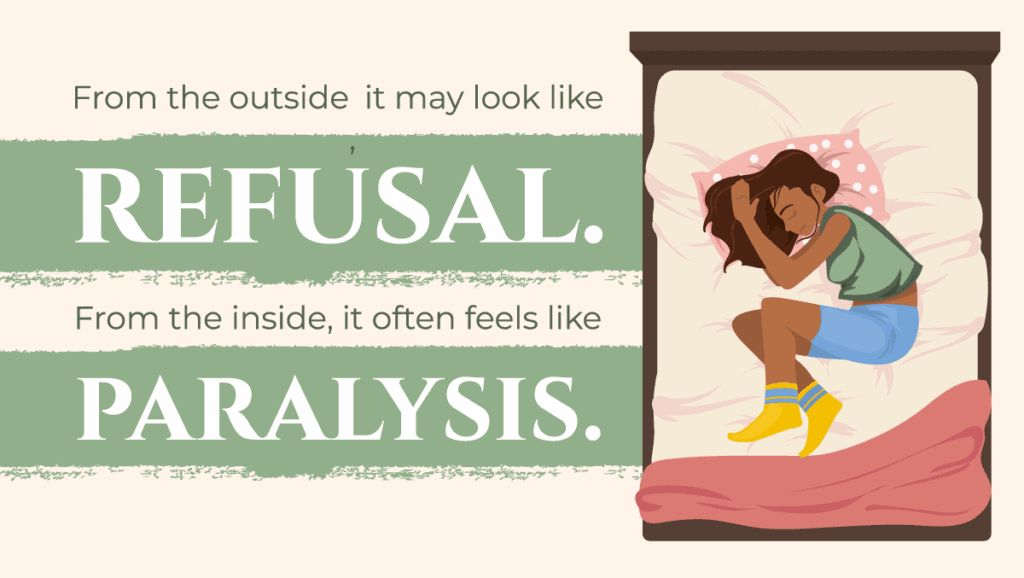
From the outside, it may look like refusal.From the inside, it often feels like paralysis.
Understanding this does not make mornings easier. But it can change the way you meet your teen.
When parents begin to see staying in bed not as a choice, but as a signal, the focus shifts. It moves away from pushing harder and toward listening closer. And that shift matters more than most families realize, because what happens in those early moments often sets the emotional tone for the entire day.
Before figuring out what to do, it helps to understand what your daughter may be experiencing beneath the surface … even when the words to explain it herself aren’t quite coming to her.
What It Feels Like From the Inside (For Teens Who Can’t Get Up)
If your daughter could explain what mornings feel like, she might not be able to find the language. Not because she doesn’t want to talk. But because the experience itself is hard to describe.
For many teens, waking up doesn’t feel like starting over fresh. It feels like being dropped back into everything they were trying to escape from the night before.
Thoughts rush in before her feet even touch the floor.
School pressure.Social worries.Fear of disappointing you.Fear of disappointing herself.
The day stretches out in front of her, and instead of feeling like new possibilities, it feels heavy. Like it’s just too much to carry all at once.
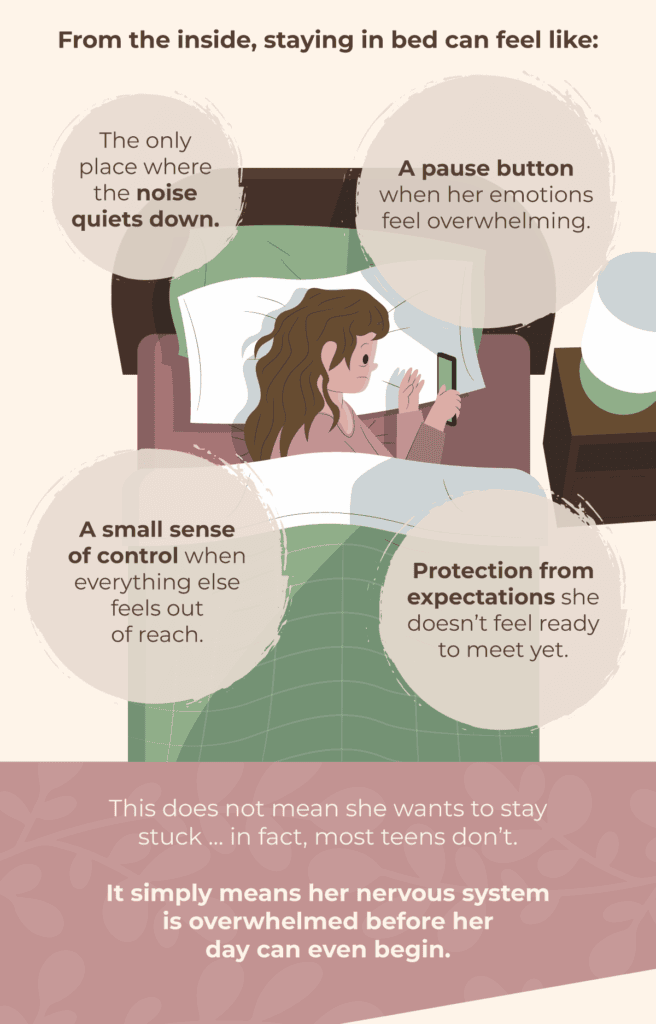
From the inside, staying in bed can feel like:
- The only place where the noise quiets down.
- A pause button when her emotions feel overwhelming.
- A small sense of control when everything else feels out of reach.
- Protection from expectations she doesn’t feel ready to meet yet.
This does not mean she wants to stay stuck … in fact, most teens don’t. It simply means her nervous system is overwhelmed before her day can even begin.
And here’s the part parents often can’t see.
Many girls feel ashamed of this internal battle. They know they’re falling behind. They know you’re worried. They may even be frustrated with themselves: wishing they could just get up like they used to.
When a teen feels like a disappointment before she has even had the chance to eat breakfast, avoiding the situation entirely can start to feel like a safer option than trying and failing again and again.
That’s why compassion in these moments is not permissive.
It’s protective.
When a teen feels like she is understood instead of judged, her body has a chance of regulating better, and her confidence has the space to slowly rebuild.
Is This Typical Teen Behavior — or a Mental Health Signal?
Every parent of a teenager has asked some version of this question.
Teenagers sleep more.
They move more slowly in the mornings.
They resist routines.
On its own, staying in bed longer than you’d like does not automatically point to a mental health concern … but patterns matter. Especially when avoidance begins to replace participation in daily life.
Instead of looking for a single “sign,” it helps to notice how mornings feel over time and whether your daughter still seems connected to her world, or if she is quietly pulling away from it.
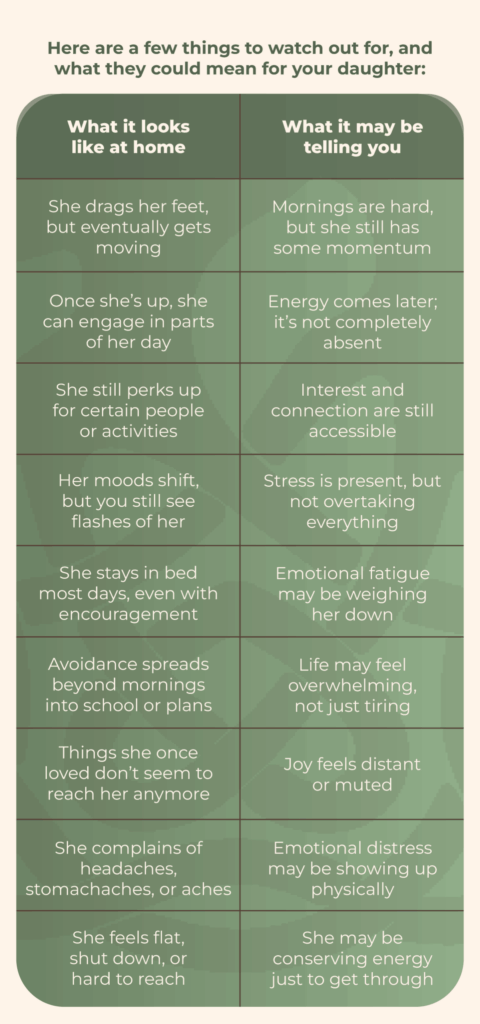
Here are a few things to watch out for, and what they could mean for your daughter:
| What it looks like at home | What it may be telling you |
|---|---|
| She drags her feet, but eventually gets moving | Mornings are hard, but she still has some momentum |
| Once she’s up, she can engage in parts of her day | Energy comes later; it’s not completely absent |
| She still perks up for certain people or activities | Interest and connection are still accessible |
| Her moods shift, but you still see flashes of her | Stress is present, but not overtaking everything |
| She stays in bed most days, even with encouragement | Emotional fatigue may be weighing her down |
| Avoidance spreads beyond mornings into school or plans | Life may feel overwhelming, not just tiring |
| Things she once loved don’t seem to reach her anymore | Joy feels distant or muted |
| She complains of headaches, stomachaches, or aches | Emotional distress may be showing up physically |
| She feels flat, shut down, or hard to reach | She may be conserving energy just to get through |
What often separates a mental health signal from typical teenage resistance isn’t their attitude — it’s exhaustion. Many teens who can’t get out of bed aren’t refusing life; they’re worn down by it.
From a teen’s perspective, being told to just push through can feel sometimes impossible when their internal load is already at such a full capacity. But from a parent’s perspective, it can feel frightening – like you are watching your child drift further away from you without knowing how to reel her back to safety.
Recognizing these signs is not about labeling or jumping to quick conclusions — it is about noticing when your support needs to change from just encouragement to understanding more deeply, extra structure, and potentially calling for help.
Meeting Your Daughter Where She Is: How to Start the Conversation
When the mornings are hard, it is natural to wonder how you are “supposed” to respond.
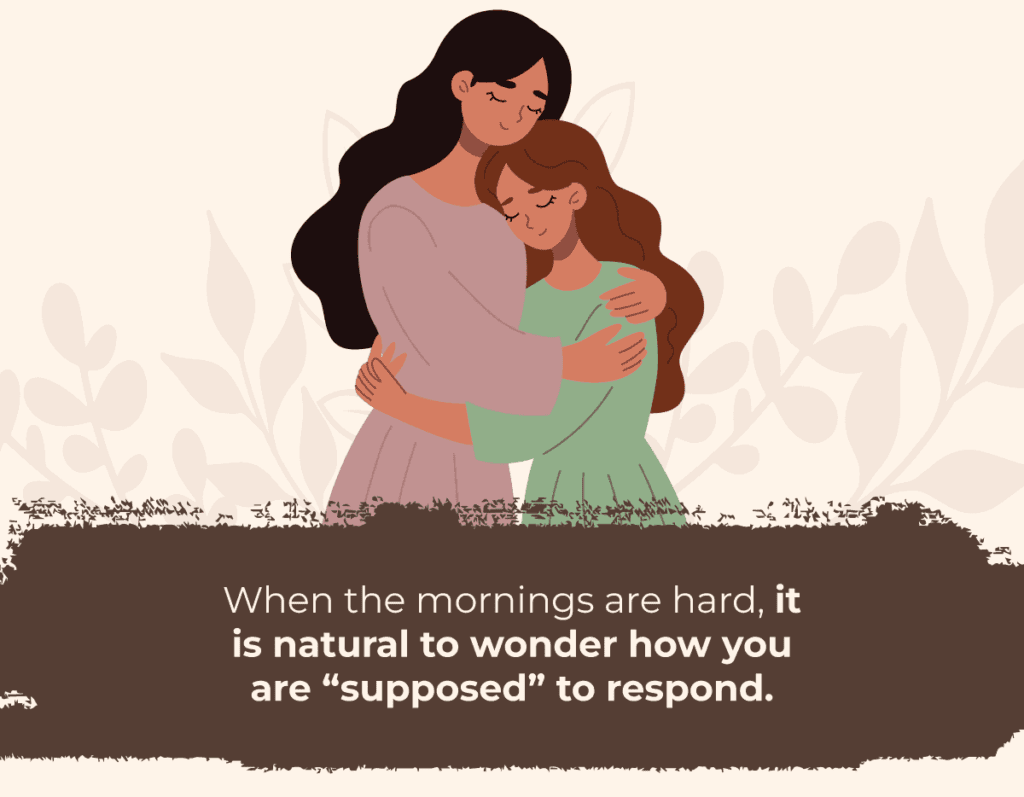
The instinct to push and lecture, or fix, comes from love.
But it is also from worry.
When a teen is already carrying exhaustion, anxiety, or overwhelm … the way a conversation goes in the morning can shape the outcome of her entire day. Coming at these moments with patient curiosity, coupled with empathy, can help preserve the trust between you, reduce her defensiveness, and keep the door to connection open.
Start the Morning Gently – Invite Her to Share
When mornings feel heavy, the idea of starting a conversation can feel nearly impossible.
But you don’t need the perfect words.You don’t need to “solve” anything.
The goal is simple. Let your daughter know you are there for her — steady, and ready to listen without judgment.
Some ways to do this include…
Focus on presence, not perfection:
- Show up consistently. Even on days when progress is minimal.
- Let her know she can always rely on you without judgment.
- Celebrate the tiny wins — even just getting out of bed five minutes earlier than yesterday is big.
Use a language of support, not control:
- Say: “I’m here to help you get through the morning.” Don’t say: “Get up now.”
- “Let’s figure this out together.” Because using, “you are falling behind” can hurt.
- Emphasize collaboration instead of compliance – teens should be able to have some control of their lives.
Create a predictable structure, but with built-in flexibility:
- Keep routines consistent, but allow adjustments needed.
- Offer gentle reminders. Not repeated commands.
- Let her influence her schedule where possible. Ownership fosters independence.
Balance your encouragement with space:
- Step in when you are needed, but step back when she is making progress on her own.
- Avoid battles for power; they rarely help.
- Trust that even small, quiet efforts matter.
Over time, these moments help her feel both seen and heard. It is not about fixing her entire day — it is about creating a space where she feels comfortable to engage at her own pace, and express how she is actually feeling.
If You Need a Little Extra Support
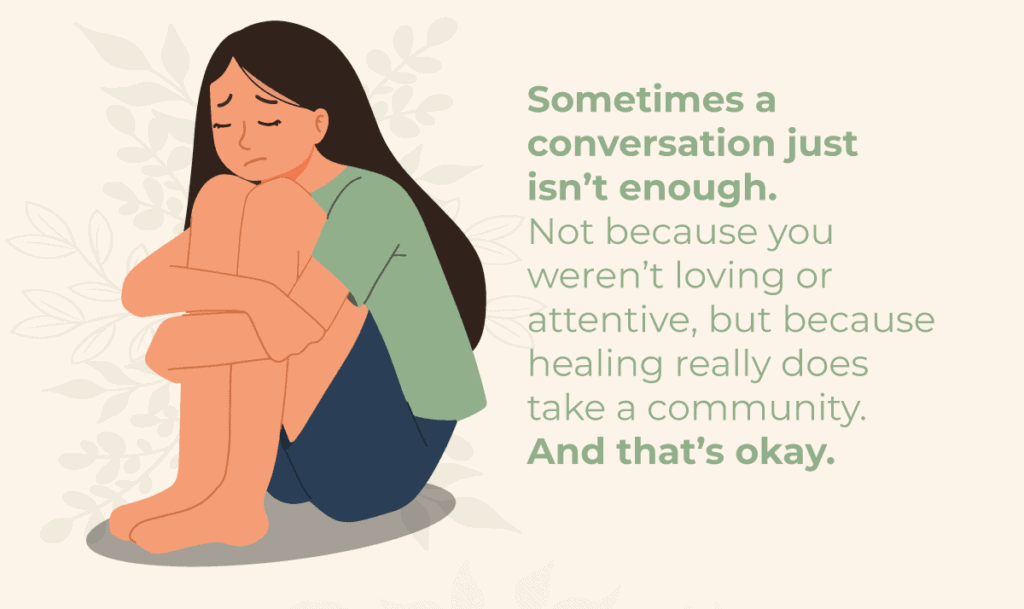
Sometimes a conversation just isn’t enough.
Not because you weren’t loving or attentive, but because healing really does take a community. And that’s okay.
Many families find that adding structured support makes all the difference in helping their daughter feel safe to engage with her day again.
One way that families can expand that support is at Roots Renewal Ranch with our program designed specifically for teen girls. We provide residential care, with a variety of therapeutic and supportive experiences tailored to her needs.
Some of these include:
- Individual Therapy – Personalized sessions help your daughter to process emotions, work through trauma, and build coping strategies in a private, supportive setting.
- Group Therapy – Facilitated group sessions allow girls to connect with peers who understand their experiences, practice communication, and gain perspective in a safe and guided environment.
- Family Therapy – Parents and caregivers are actively involved – learning tools to support their daughter, rebuild trust, and strengthen communication at home.
- Structured Daily Routines – From therapy and skill-building activities to healthy meals and recreational time, routines provide consistency and stability that support emotional regulation and growth.
- Mentorship and Community Support – Caring staff and peer mentors guide each girl’s journey, helping her feel understood, encouraged, and part of a supportive community.

Every component of the program is focused on helping teen girls regain their confidence and reconnect with themselves, while gradually reengaging with everyday life. We combine therapy and mentorship with a caring community, to create a space where recovery is not just a goal, but an actual lived experience. One that families can learn to navigate together.
Guiding Your Daughter Back to Confidence and Connection at Roots
When it feels like mornings are nearly impossible, and your daughter seems stuck, it can be hard to know where to turn…
At Roots Renewal Ranch, our farm is a safe space where teen girls can relearn to process their emotions, practice new coping skills, and rebuild confidence at a pace that feels manageable.
Families should be a part of the healing process, too. That’s why we offer family therapy and guidance so parents can learn how to support their daughters with empathy and consistency, fostering trust and connections at home. Roots helps girls to move forward without judgment – offering steady care and a community that encourages them to re-engage with life.
For parents who want to learn more about our programs or how Roots can support your daughter; reach out today at 888‑399‑0489.
Every step of the journey matters, and help is just a call away.
She is strong, she is loved, and she is enough.
