21% of high school girls in the US created a plan for suicide in 2023. That’s over one in every five teenage girls experiencing suicidal ideation.
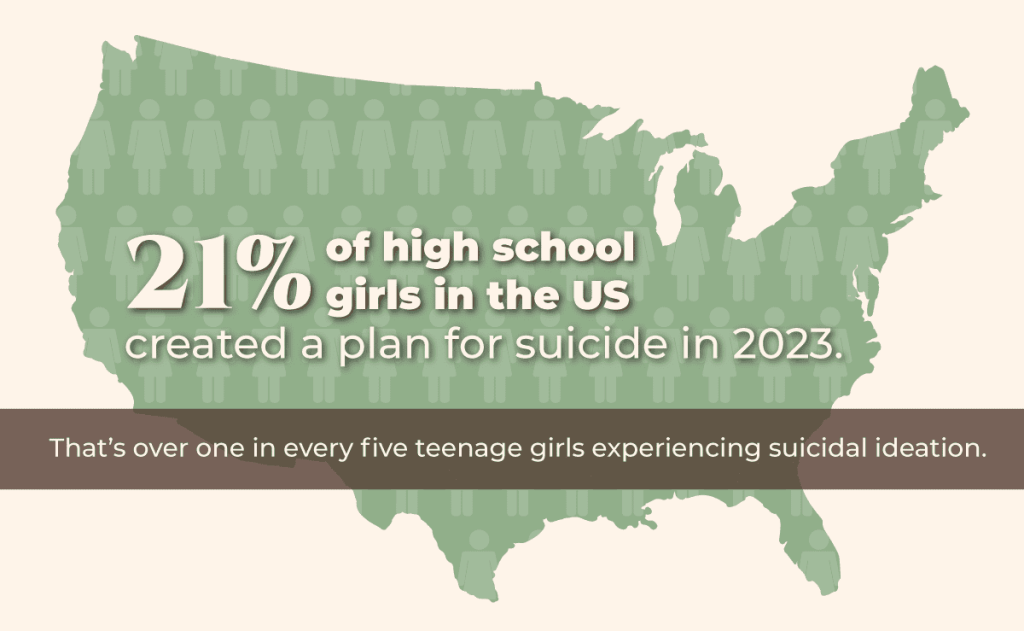
That’s a startling statistic, and it should be a wake-up call for us as adults.
We hear the words “mental health crisis” a lot, but it’s usually about the amount of pressure and mental health difficulties our teens experience as a collective group. That’s certainly a concern – but what about when it’s your daughter?
How do you know what a teen girl experiencing a mental health crisis looks like, and what can you do to help?
Let’s answer those questions. Knowing this information could make a major difference in your daughter’s life.
Starting With the Basics: What Is a Mental Health Crisis?
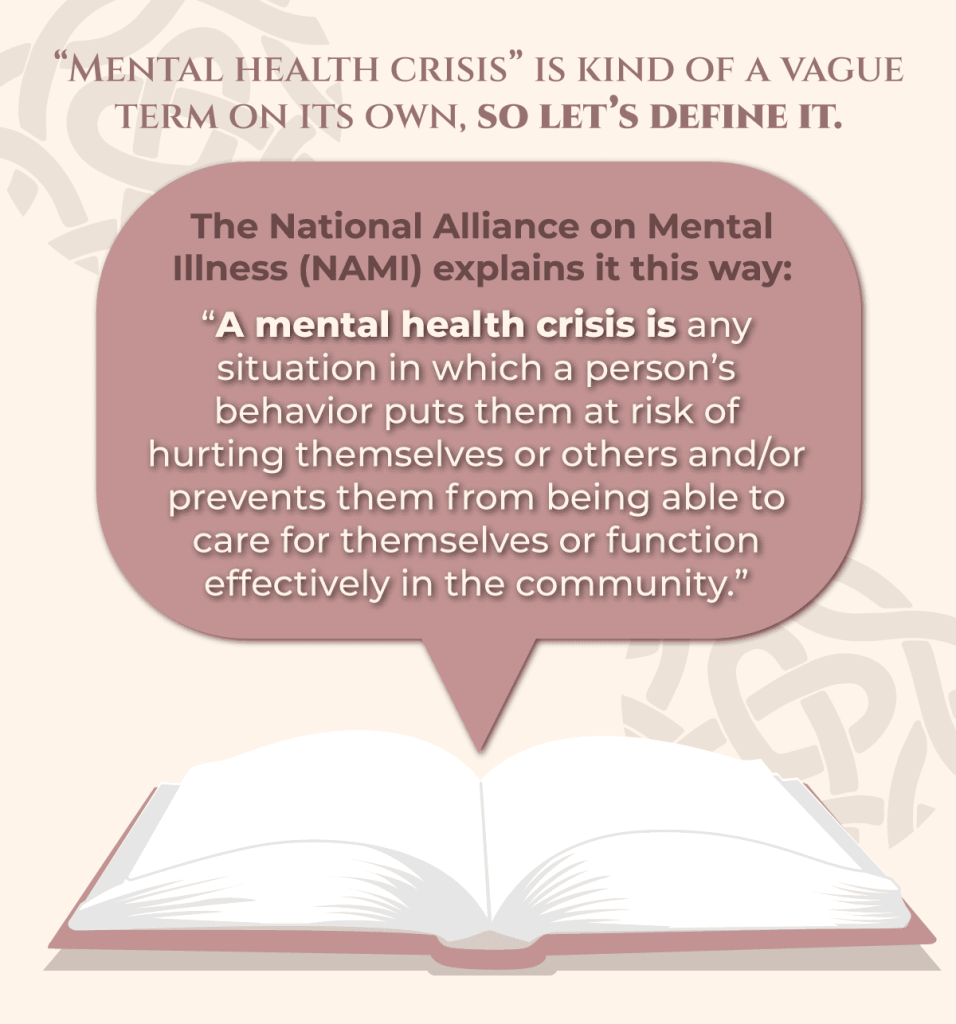
“Mental health crisis” is kind of a vague term on its own, so let’s define it. The National Alliance on Mental Illness (NAMI) explains it this way: “A mental health crisis is any situation in which a person’s behavior puts them at risk of hurting themselves or others and/or prevents them from being able to care for themselves or function effectively in the community.” This definition is widely accepted in the behavioral health space, so we’ll abide by it here, too.
Then, there becomes a need to differentiate between mental health crises that require immediate intervention, and crises that can pass with extra support and some time. We’ll call the crises you need to take action for right away “mental health emergencies.”
Let’s be clear: no matter the mental health crisis a girl is going through, she needs help. These are serious situations, and a less severe mental health crisis can progress into a mental health emergency if it isn’t addressed.
Examples and Signs of a Mental Health Crisis: How Do You Know if It’s an Emergency?
Before you can take action to help your daughter, you need to determine if she’s experiencing a mental health emergency or a less critical crisis. To know that, you have to assess her symptoms. Let’s break it down.
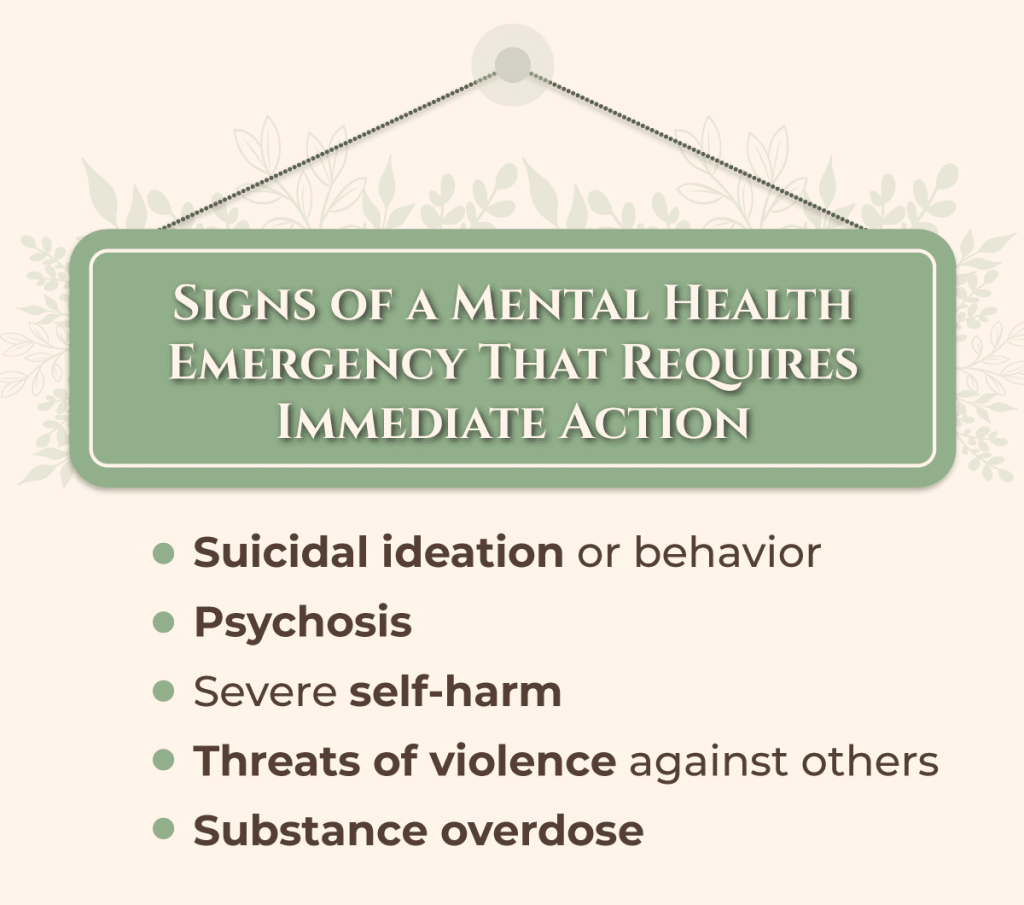
Signs of a Mental Health Emergency That Requires Immediate Action
If your daughter is experiencing any of these symptoms, it’s time to get help for her as soon as possible:
- Suicidal ideation or behavior. This includes suicide attempts and actively planning and intending to attempt suicide. If you have any suspicion that your daughter might be experiencing suicidal ideation, ask her. Be straightforward, even if it’s uncomfortable.
- Psychosis. Psychosis is a general and serious detachment from reality. A person in psychosis often sees, hears, or smells things others can’t (hallucinations). They also might be convinced of things that aren’t true and don’t make sense to you (delusions). They are often agitated or paranoid and say things that seem strange. People experiencing psychosis rarely realize anything is wrong with how they’re acting.
- Severe self-harm. If your daughter self-harms frequently or gives herself serious injuries, her self-harm would fall under this category. It doesn’t mean she’s experiencing suicidal ideation, but it does mean she’s in a lot of emotional pain that should be addressed as soon as possible.
- Threats of violence against others. If your daughter is making threats to hurt other people, it’s best to take them seriously, especially if she expresses a desire to kill others. This doesn’t mean your daughter is a bad person – it just means she needs immediate mental health support.
- Substance overdose. If you think your daughter is overdosing on a substance, including alcohol, get her medical attention right away. Once she’s physically safe and stabilized, it’ll be important to address why she was using the substance in the first place with a mental health professional.
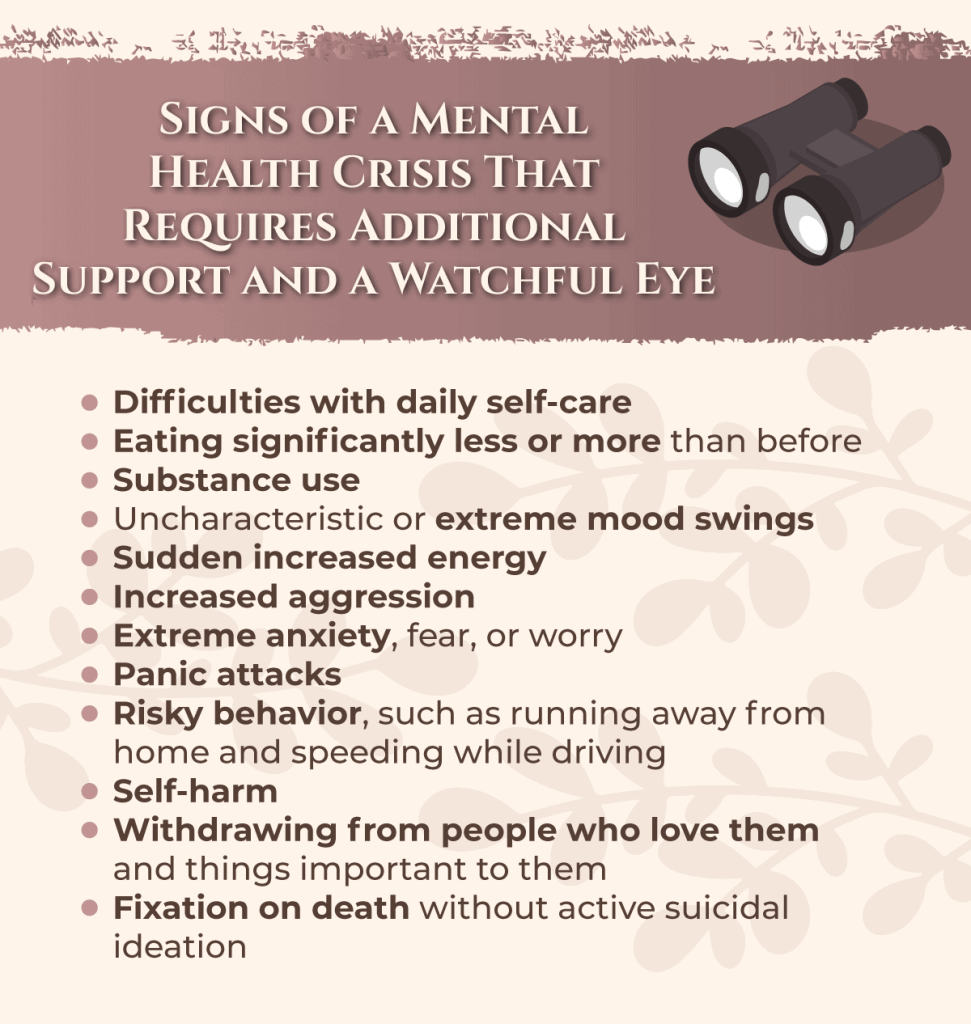
Signs of a Mental Health Crisis That Requires Additional Support and a Watchful Eye
Even though these signs don’t require the same critical attention as the ones above, they’re still important to address. Don’t dismiss any mental health crisis as something that will pass on its own. Even though the course of action is different, your daughter still needs additional support if she’s experiencing:
- Difficulties with daily self-care
- Eating significantly less or more than before
- Substance use
- Uncharacteristic or extreme mood swings
- Sudden increased energy
- Increased aggression
- Extreme anxiety, fear, or worry
- Panic attacks
- Risky behavior, such as running away from home and speeding while driving
- Self-harm with minor injuries
- Withdrawing from people who love them and things important to them
- Fixation on death without active suicidal ideation
How Do You Help During a Mental Health Crisis? Practical Applications
The best thing you can do during a mental health crisis to help is talk to your daughter. Ask her what she thinks will help her. Sometimes she may not know the answer to that question, and that is okay. That’s where these tips will come in handy.
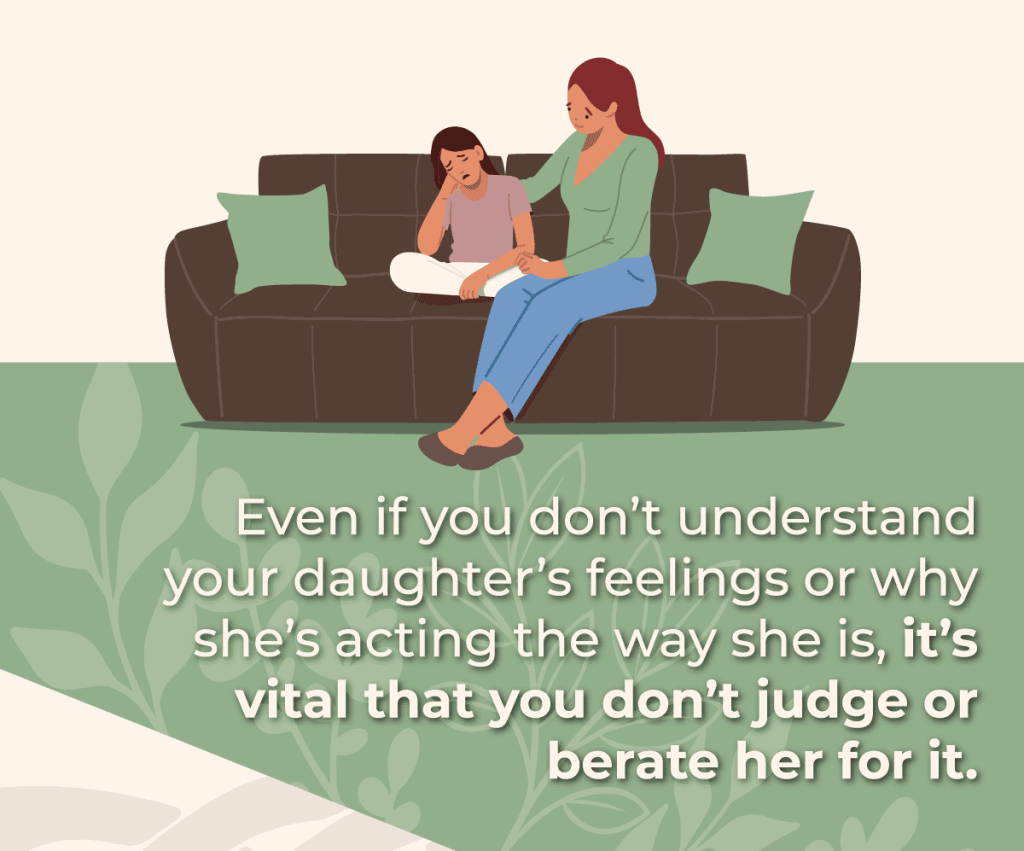
No matter what, stay calm, speak gently, and approach the situation with compassion. Even if you don’t understand your daughter’s feelings or why she’s acting the way she is, it’s vital that you don’t judge or berate her for it. Keep an open mind and heart, and listen when she talks to you with the intent to understand her on a deeper level. Even though you may have things you want to say, her needs should be front and center at this time, so you might need to put your own thoughts on the back burner for a bit.
It’s a good idea to contact a mental health professional, no matter the depth of the crisis. What kind of professional you contact will depend on the situation.
How to Help in a Mental Health Emergency
A mental health emergency requires immediate action. What does that action look like? You have a few options.
One option is to call the national mental health emergency number, 988. 988 has trained mental health counselors available 24/7. They will offer advice based on your daughter’s situation, and if they can’t de-escalate the crisis through the call, will connect you with local resources to get her the help she needs as soon as possible.
You can also call a local mental health crisis line. In Texas, we have different mental health crisis numbers and mental health authorities for every part of the state. They’re very familiar with the mental health care available in their area and will know what’s most appropriate for what your daughter is going through.
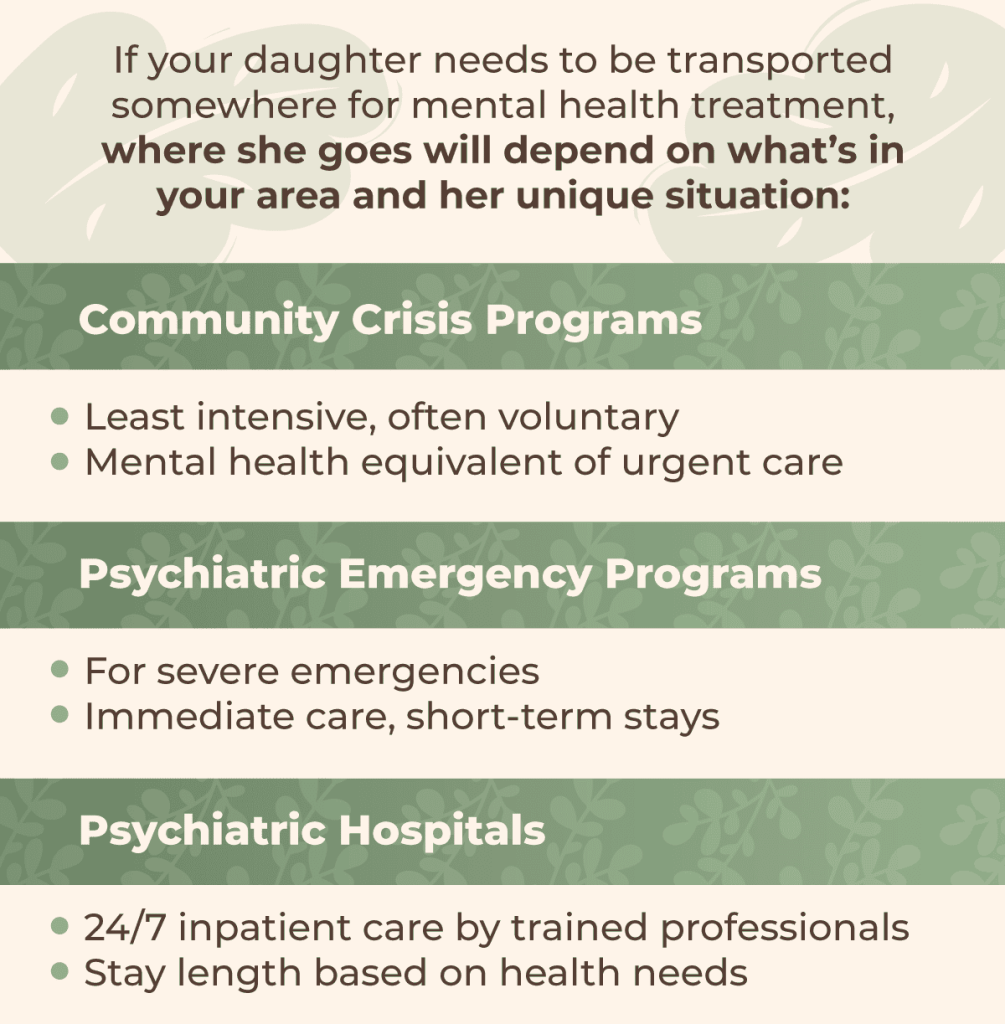
If your daughter needs to be transported somewhere for mental health treatment, where she goes will depend on what’s in your area and her unique situation. Here are some common crisis facilities and how they generally work:
- Community crisis programs. These are the least intensive facilities and usually have patients who are there voluntarily. They’re commonly considered the mental health equivalent of urgent care, while other facilities would be more equivalent to the emergency department.
- Psychiatric emergency programs. These facilities are for serious psychiatric emergencies, including people who were forcibly brought there for their own safety or the safety of others. People here will receive immediate psychiatric care, but won’t stay long-term.
- Psychiatric hospitals. Your daughter will typically stay here on an inpatient basis, where she’ll be looked after by highly-trained mental health and medical professionals 24/7. How long she stays will depend on the facility and what’s necessary for her health and safety.
The idea of your daughter being hospitalized for a mental health emergency can be terrifying, but sometimes it’s the best and safest place for someone to be. There’s no shame in that, and it can be incredibly helpful.
How to Help if the Crisis Isn’t Critical Yet
If you recognize the signs of a mental health crisis in your daughter but no one’s safety is immediately at risk, the best thing you can do is talk to her. Let her know you’re concerned, that you love her, and that you’re there to listen if she has anything she wants to talk about.
It’s also a good idea to spend more time with her, whether that means family movie nights or just sitting quietly in the same room together while you do different things. Just the presence of another human being can make a difference, especially if that person is a family member. Plenty of research points to family involvement as a huge factor in preventing and lessening mental health crises in girls. For example, significantly more adolescents in mental health crisis care lacked family involvement in their lives, as opposed to patients whose families were involved.
You’ll also want to consult with your daughter’s mental health provider if she has one. Let them know what’s going on. If she doesn’t have one, it’s a good idea to look into a therapist or other mental health treatment for her.
One option for treatment is a residential center, like Roots Renewal Ranch. We offer a safe, welcoming home away from home for teen girls to focus on healing and growing into healthier, happier people. Girls will participate in various daily therapies, have dedicated time for education, and in the case of Roots, take care of the many animals we have on our ranch. She’ll also learn life and coping skills to help her tackle any mental health condition she’s facing, and return to regular life recharged and ready to take on the world. Because family involvement is so key to girls’ mental health, we also make sure their families are included every step of the way.
Preventing a Future Mental Health Crisis: Treatment Modalities and Strategies to Build a More Peaceful Life for Your Daughter
Once your daughter heals from her mental health crisis, there will be some work to do to make sure she stays safe and stable.
One aspect of that is keeping your daughter’s school in the loop on what’s going on. Positive teacher-student relationships are especially important – to the point that one study found self-harm rates were lower for high school students who had a good relationship with a teacher. We also know that school connectedness, or students believing people at school care about them, improves mental health in teens. Keeping counselors informed allows them to better understand and help your daughter while she’s at school, too. Schools are becoming progressively more understanding of the importance of mental health. You might even be able to get accommodations for your daughter if needed so she can be more comfortable and thrive.
What Mental Health Treatment Works Best for Teenage Girls?
There are a lot of different mental health treatment options out there, and it can be overwhelming. It’s also hard to know what will help your daughter the most.
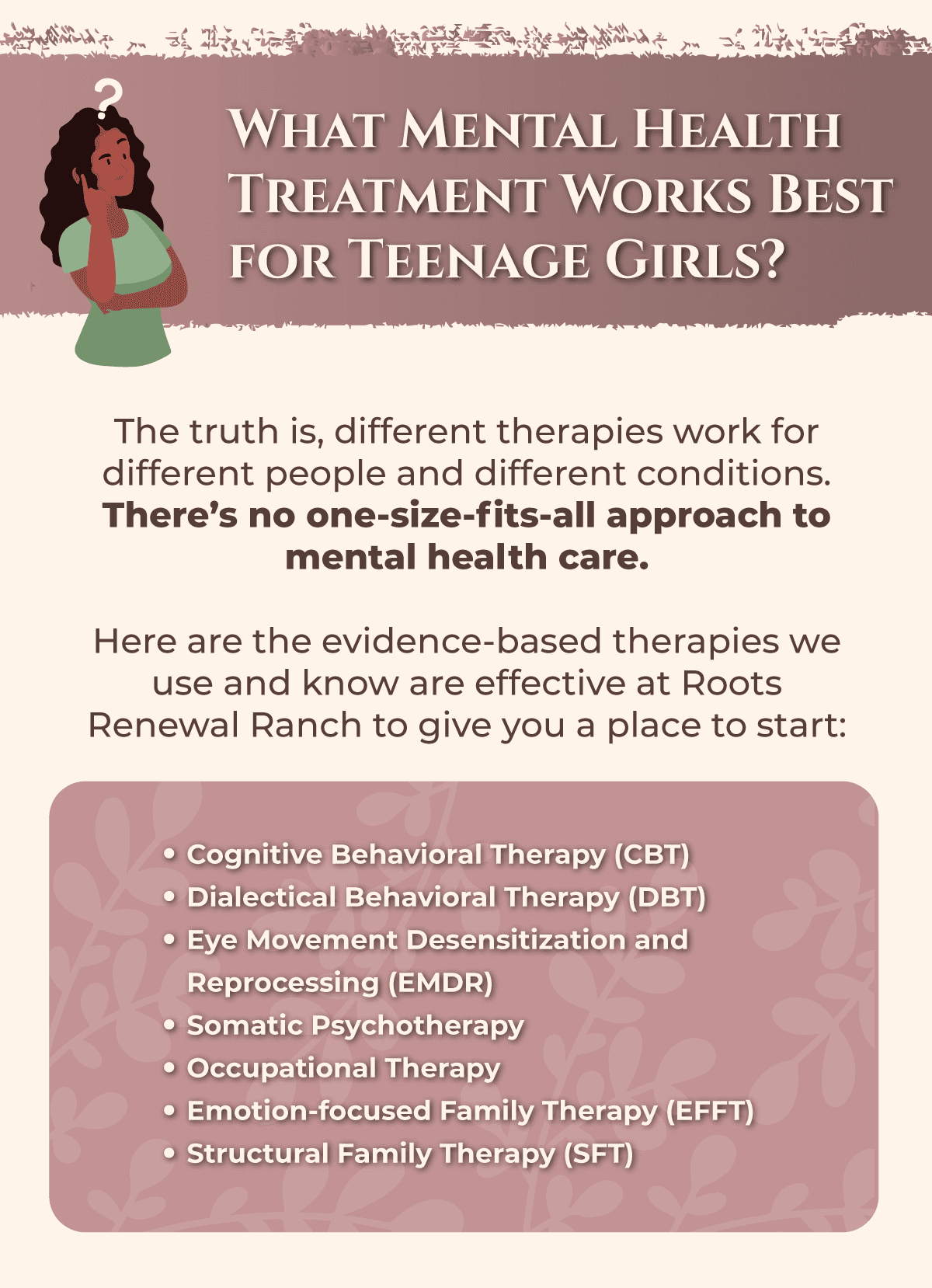
The truth is, different therapies work for different people and different conditions. There’s no one-size-fits-all approach to mental health care. That means you might just have to try things until you find what works best. Here are the evidence-based therapies we use and know are effective at Roots Renewal Ranch to give you a place to start:
- Cognitive behavioral therapy (CBT). This is the most widely used therapy for good reason. Research indicates CBT can improve anxiety, ADHD and eating disorder symptoms, substance use, depression, and more mental health symptoms in teenagers. CBT focuses primarily on helping girls recognize and change unhelpful thought patterns that influence their behavior.
- Dialectical behavioral therapy (DBT). DBT helps girls identify, process, and manage their strong emotions. It’s been found effective at treating self-harm and suicidal ideation in teens and is an especially important component of treatment for borderline personality disorder (BPD). One study found that 77% of BPD patients no longer met the criteria for a BPD diagnosis after one year of DBT.
- Eye movement desensitization and reprocessing (EMDR). EMDR involves eye movements as part of therapy to help teens process trauma in healthier ways. It can also be used for other conditions sometimes. For example, 60% of teens with major depressive disorder (MDD) no longer met the criteria for MDD after six weeks of EMDR in one study.
- Somatic psychotherapy. This therapy involves typical talk therapy, but with an additional focus on physical associations as the girl talks. It can involve meditation, breathing exercises, massages, and more. Research indicates somatic psychotherapy helps with trauma, mood, and physical symptoms related to psychological distress.
- Occupational therapy. This can vary widely, but always involves active participation in activities to grow, tackle mental health obstacles, and build new skills. We use occupational therapy a lot at Roots Renewal Ranch. One of our major focuses is animal therapy, and having the girls take care of them. Research shows occupational therapy helps teens with emotional and behavioral health concerns improve self-determination skills.
- Emotion-focused family therapy (EFFT). EFFT is used to support you as a parent so you can be an active part of improving your daughter’s mental health. It helps parents work through their own emotions and strengthen relationships with their teens.
- Structural family therapy (SFT). SFT works to build harmony and improve communication between family members. It’s shown to improve how teens manage their problems, improve family cohesion, and help parents develop healthier parenting styles.
You Don’t Have to Do This Alone: Help for Girls’ Mental Health Crises in Texas
When your daughter is experiencing a mental health crisis, talking to her is the most important place to start. Learn what her biggest concerns are. Consult with any medical and mental health professionals in her life, from primary care physicians to school counselors. They’ll be able to offer suggestions, but keep in mind – your daughter is on her way to becoming a strong young woman. That means her thoughts on the care she receives are important. She should be part of the decisions that will impact her mental health journey when it’s possible.
At times, it might not be possible, and you’ll have to make some difficult decisions on her behalf. We hope this article will be a valuable resource, and that you remember you and your daughter aren’t alone. Don’t be afraid to seek out support for yourself, too, and know Roots Renewal Ranch is always here to help.

Roots Renewal Ranch is a residential mental health facility for girls ages 13-17 in the Dallas-Fort Worth area. We keep families involved during every stage of their daughters’ treatment and are mindful of any trauma she’s experienced, guiding therapy in a way that respects that and helps her heal. She is strong, she is loved, and she is enough. Call us at 888-399-0489 for more on how we can help.

